Zimri Brewer Heywood: separating
fact from myth2 September 2008
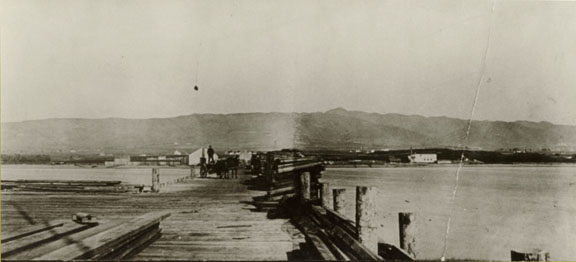
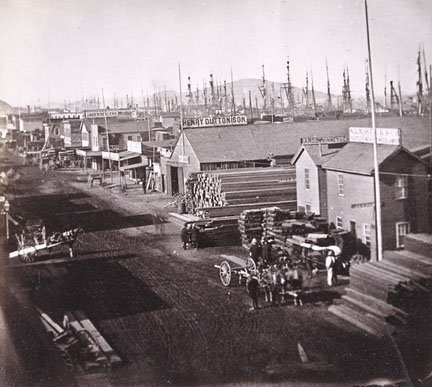
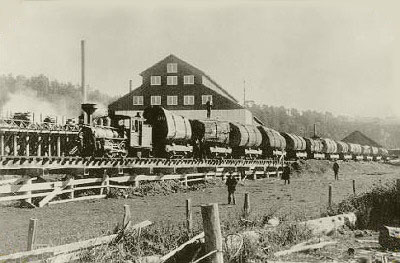
Heywood & Jacobs’ lumber wharf, c. 1868 (BAHA archives, from Louis L. Stein collection)
As Planet Berkeley hurtles away from its past, the figures who dominated its early days, having accumulated a comet-like tail of stories and quasi-histories, take on the burnish of legend. Enshrined in books and articles, these stories have been repeated long enough to be taken for fact.
But what are we to believe when the stories carry conflicting dates, names, and locations?
Most people who are interested in Berkeley’s history will have heard the name of Zimri Brewer Heywood. He is best known as the owner of the town’s earliest lumber yard, partner of Captain James H. Jacobs in Berkeley’s first wharf, and the father of thirteen children, including two mayors and a California Assembly member.
When did Zimri Heywood come to Berkeley? When was his business established here? Where did the Heywoods live in their first years out west? The answers to these questions are many and varied, depending on the source you choose to read. A great many of the accounts were published in the 20th century, relying on word of mouth or on other 20th-century sources. But what picture emerges when the Heywoods’ odyssey is reconstructed exclusively from 19th-century records and documents?
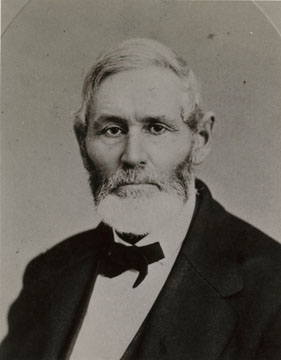
Zimri Brewer Heywood at the age of 72 (Heywood family collection)
Zimri Brewer Heywood was born on May 24, 1803 in Winslow, Maine. Prior to his arrival in California, he lived at times in Calais, ME, at others in St. Stephen or St. James, New Brunswick. His frequent cross-border moves had nothing to do with globetrotting. It happens that Calais and St. Stephen are practically one community, bisected by the St. Croix River, while St. James lies a mere ten miles north of St. Stephen.
While living between Maine and New Brunswick, Zimri Heywood married four women within a span of 22 years, the first three wives dying at the age of 30, 29, and 26, in that order (see a table listing Zimri’s wives and their children). The U.S. census of 1840 found Zimri in Calais, heading a large household that included two males under five (sons Franklin and Albert); three males aged 5 to 10 (sons William B., Charles, and Samuel); one female aged 15 to 20; one male aged 20 to 30; two females aged 20 to 30 (one of them his second wife, Jane Scott); three males aged 30 to 40 (including himself); and one female aged 30 to 40; 13 persons in all.
During the 1840s, Zimri was involved in at least three lawsuits—either as plaintiff or defendant—involving property rights or debt. On 24 July 1850, the Heywood household, now reduced to nine persons, was still residing in Calais and included the fourth wife, Ann Bullock, and seven children from all four marriages. Zimri’s occupation was recorded as “millman,” his estate was worth $5,000, and his sons Charles, 18, and Samuel, 16, worked for him as laborers.
If you’ve read any of the accounts relating how the Heywoods set out for California in September 1849, sailing around Cape Horn and arriving in San Francisco in early April 1850, you might be wondering how they accomplished this feat only to return home less than four months later. One possible answer is that Zimri went on a scouting expedition ahead of the family, in which case he couldn’t have stayed long and had to hightail it on the way back.
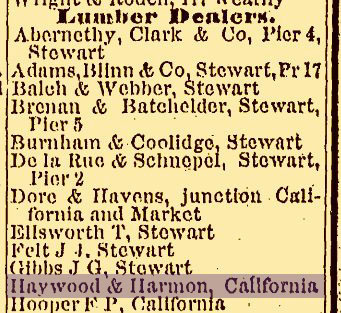
San Francisco Municipal Register, 1859 (sfgenealogy.com)It’s been claimed in several books that Zimri Heywood established his West Berkeley lumber yard in 1856. If this is the case, no record has been found to substantiate the date. The Heywoods did arrive in California some time in the 1850s, for several records exist that place them in the Bay Area by 1860. One of these is the San Francisco Municipal Register of 1859, listing the firm of Haywood [sic] & Harmon, California St., among the city’s lumber dealers. Zimri’s partner was Samuel H. Harmon (1826–1907), another Maine native.
The 1860 U.S. census recorded Zimri and Ann Heywood in San Francisco with three young children and the 22-year-old Franklin. Zimri was listed as a lumber merchant with $3,000-worth of real estate, and Franklin was a clerk, presumably at Heywood & Harmon.
Also in 1860, Zimri’s oldest living son, William Brewer Heywood (b. 1830), was a brick mason living in San Francisco with his bride of two years, Salome. Of his two full brothers, Charles Warren (b. 1831) and Samuel (b. 1833), there is no record that year. According to Past and Present of Alameda County California, Vol. II, published in 1914, Charles “engaged in the sheep business in the Napa valley for many years, driving his sheep to market from Napa to Oakland.” (The 1870 census listed Charles as a dairyman in Oakland.) Samuel reportedly made his home for a while in the Gold Rush town of Camptonville.
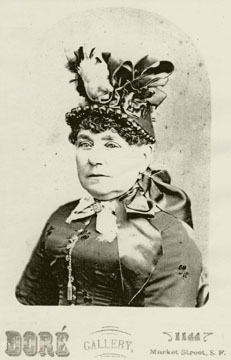
Ann Bullock Heywood, 1887 (Heywood family collection)
The Steuart Street wharf, San Francisco, 1866 (Society of California Pioneers)By 1863, both William and Franklin were working as clerks at Heywood & Harmon, then located at 43 Steuart Street, on Pier 4. In 1866, Franklin registered to vote as a lumber dealer and William as a bookkeeper. Both lived on Polk Street between Sacramento and California, while their father resided at 1121 Kearny Street. Two years later, William lost his wife in the Oakland Ferry Disaster of 4 July 1868. Salome was one of the holiday makers about to return to San Francisco on the ferry El Capitan after a day of festivities in Oakland. While transferring from the train to the ferry, the gangplank connecting ship to shore gave way, hurtling at least ten passengers to their death. William was left with two small sons to raise.
Already in 1860, and perhaps earlier—before any Heywood lived in Berkeley—Zimri Heywood thought it wise to invest here. He acquired a tract of 2,900 acres in the Berkeley Hills, east of La Loma Park and about a mile north of the proposed campus of the College of California, and occupied (although did not reside in) a part of it known as the Ramsey Ranch. On 4 September 1860, Zimri executed a deed to the College president and board of trustees, granting them in perpetuity the exclusive right to collect water from the springs on his land, the amount of water not to exceed the capacity of a round pipe of three-inch bore, the balance of the water being reserved for the use of the ranch. A synopsis of the deed was duly recorded in the Journal of the California Senate and Assembly.
In 1875, the land was partitioned among several tenants in common. Inevitably, one of these, Laura Pfeiffer, was not pleased when the institution—now the University of California—continued diverting large volumes of water from her land, and filed suit. The matter progressed through appeals all the way to the California Supreme Court, where it was found that “for three years and ten months immediately preceding the trial, the defendant so diverted and used 10,000 gallons per day, in addition to water sold by it to others, for which it received $4,804.” In November 1887, the Court found for Pfeiffer, holding that “the defendants, as tenants in common, could not by reservation in their deed create an easement or servitude on the common land as against their co-tenant.” It was a rare instance in which a citizen prevailed against U.C.
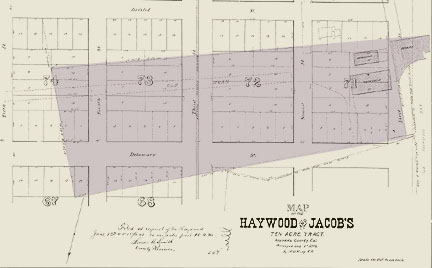
Map of Heywood & Jacobs’ 10-acre tract (courtesy of Jerry Sulliger)By 1868, Zimri Heywood had entered into his celebrated partnership with Captain James H. Jacobs (1825–1896), the Danish master mariner who operated Jacob’s Landing in Ocean View. As shown in an Alameda County map dated 1874, the two acquired ten acres of land amounting to roughly three city blocks, extending diagonally from the bay shore to midway between 4th and 5th Streets between Bristol (now Hearst) and Delaware. Their lumber yard and warehouses were located on the waterfront, current location of the Eastshore Freeway.
On 3 March 1868, the California Senate and Assembly passed an Act to authorize Z.B. Heywood and J.H. Jacobs to construct a “wharf in front of their property at Jacobs’ or Ocean View Landing [...] for the term of twenty years, commencing at high water mark and running into the Bay of San Francisco to deep water, provided said wharf shall in no manner interfere with the navigation of said bay, and that it shall be completed within one year from the passage of this Act; and said wharf shall not exceed in width one hundred feet.” Heywood and Jacobs were authorized, if they saw fit, to “collect such rates of toll and wharfage as may be fixed upon by the Board of Supervisors of Alameda County.”
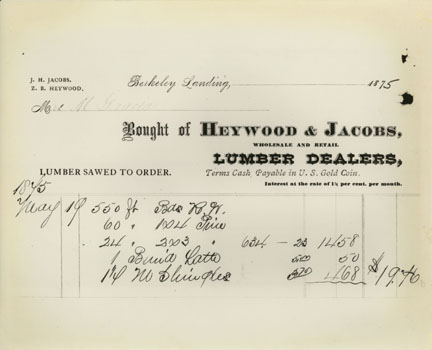
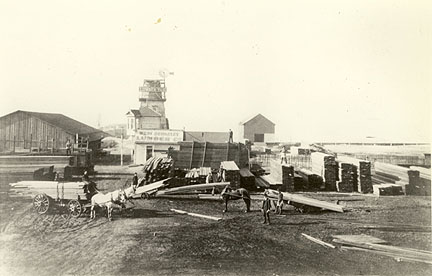
BAHA archives, from Louis L. Stein collectionWhile Zimri remained in San Francisco, his son Samuel was the one Heywood who moved to Berkeley to run the lumber business with Jacobs. Sam lived in the Jacobs family house, where he was listed in the 1870 census. The West Berkeley Lumber Yard supplied the construction material for the first building on the University of California campus.
West Berkeley Lumber Company, 1890s (BAHA archives)But this business appears to have been a small affair compared to Zimri’s other lumber concerns. Possibly around 1872, he acquired an interest in a small sawmill in Gualala, Mendocino County. His son William was dispatched there to run it. Heywood, Harmon, and Captain Charles L. Dingley—the latter another Maine-born lumber magnate—incorporated the Gualala Mill Company in 1876 and built a modern, high-production mill at Mill Bend on the Gualala River. William B. Heywood managed it for several decades, and his brother Franklin eventually served as president.
A timber-laden train of the Gualala River Railway in front of the Gualala Mill (gualala.com)The mill employed 150 men, and the Heywoods built Gualala’s first schoolhouse, allowing local children to live in town instead of boarding elsewhere. In 1891, the company built the Gualala River Railway, which operated a 12-mile track from Bowen’s Landing to Logging Camp. The equipment comprised four freight locomotives and 32 logging cars.
In 1873, along with four other San Francisco lumber dealers, Heywood & Harmon commissioned Isaac Hall to build a 107-ton, two-masted schooner for transporting lumber to their yards. Launched in April of that year, the vessel was named the Z.B. Heywood. Its namesake lived another six years, spending his final year in West Berkeley.
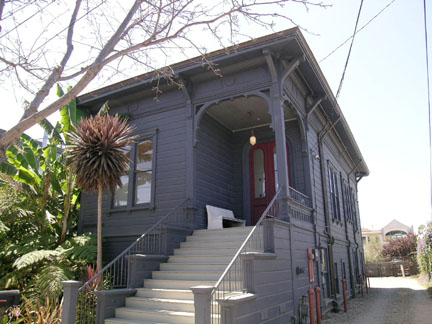
1808 Fifth St., the elegant Italianate residence built in 1878 for Zimri Heywood’s son Charles. (Daniella Thompson, 2008)This is the first in a series of articles on the Heywood family.
Part 2: On the Trail of Zimri Brewer Heywood’s Residence
Part 3: Will the Real William Heywood Stand Up?
Part 4: Samuel Heywood and Sons: Lumber and Politics
Addendum: Zimri Brewer Heywood’s Wives and Children
The author is indebted to Jerry Sulliger and Jean Darnall for their many valuable contributions.
This article was published in the Berkeley Daily Planet on 4 September 2008.
Copyright © 2008–2022 Daniella Thompson. All rights reserved.